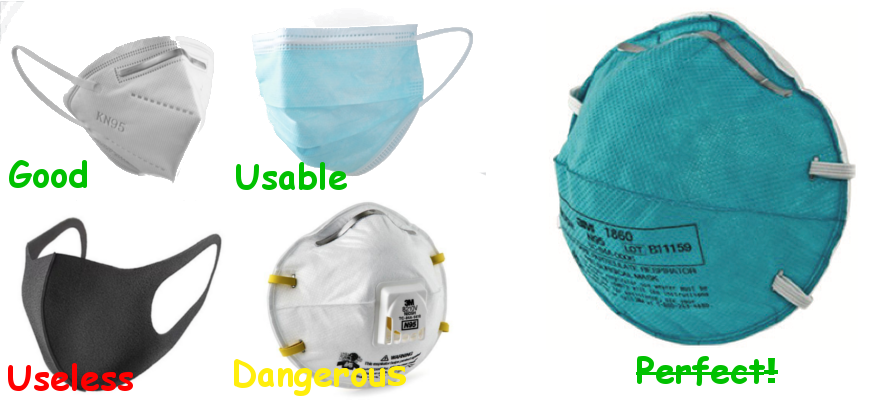
Within a number of weeks we’ll all be allowed to go out, unrestricted, to wherever we go. No one knows exactly when, but for sure, we will. With one caveat: we will all wear a face mask. One of the reasons why people are not allowed to go out freely, is exactly the fact you’ll need a face mask, and there aren’t any available, that is, until the health system is properly provisioned with those. And accordingly to recents news, that will still take awhile…
In fact, one of the reasons some countries are credited to maintain such a low infection rate (see Czechia and Austria) is the mandatory use of face masks on all public spaces, and apparently there’s no shortage of those in Eastern Europe.
So, we’ll need to pick a bunch of them, out of the tens of models available, not all are adequate. Some are just useless, others offer some protection, others protect you and the community, others only you, and all combinations thereof.
Let’s have a quick look at them:
The cloth mask

However, don’t get the looks fool you. Recent studies have found that these masks have a very limited filtering [1], as low as 35%. However, the bad news don’t end there. If people assume they’re protected by these masks, it actually actually makes them more prone to infection [2]. These masks are offer very low protection. Use them if there’s nothing else. These masks have two major problems:
- simple cotton cloth has very poor filtration characteristics, specially on the small particles the virus travels in. The reason for this is simple, and resides on how fabrics are made: by crisscrossing strands of cotton, it leaves holes between the strands, resulting on a very particular pattern.
- not only it has very poor characteristics, but the particles it does filter are absorbed into the fabric, which poses another infection risk, as these masks are intended to last at least a full day until being washed. If the virus is trapped on the fabric and the user touches it several times a day, we have another infection vector.
- high air leakage. These masks don’t often have the proper shape of the face, and allow air to leak through the sides, both inbound and outbound. This characteristic is shared with surgical masks, and the reason why people should avoid surgical masks.
In sum, please avoid using these masks, as they offer little protection for the user and the community alike. Use them only if you don’t have any other way to cover your face. These masks are often quite expensive, between 3 and 12 pounds per mask, but interestingly enough, they’re not found on most online stores, especially Asian online stores, due to the poor filtering performance of pollutants.
The cloth mask, enhanced with a filter


How does it work? These masks are made with an insert which allows to put an actual filtering medium, which can either be a common non sterile non-woven swabs, or a high performance PM2.5 filter. On this masks, both end up having the same performance, as one of the same flaws are maintained: high air leakage as there’s no proper air tightness around the face, and the filtering material also doesn’t cover the whole mask.

However, the end result is strikingly different. If a simple non-woven insert is used, it has a similar performance as a surgical mask, if a high performance PM2.5 filter is used, it’s as good as surgical mask [1]. How better is impossible to know, as it depends on how much air leakage there is, or much much the filter actual covers the whole mask. The end result an improvement nonetheless: it allows you wear something fashionably distinct, without the distinct look a surgical mask.
From a cost perspective things are a bit different as compared with a simple cloth mask, but still cheaper than surgical masks. The cloth mask with an insert will cost you some 5€ apiece, but only if you buy abroad, as they painfully hard to find now, and filtering materials will vary depending on material, quantity and where you buy from. Today, and this needs to be looked at a daily perspective, these filters can be purchased from 0.20€ at some Asian stores to 0.50€ at Amazon or similar.
The surgical mask
 These used to be the most common piece of protective equipment any health worker is used to have nearby, ubiquos on dentists offices, beauty salons and spas, but apparently not so on nursing homes…
Their basic construction makes them very effective at what they were designed to do, at an extremely effective cost. These masks were designed to maintain aseptic separation between the health worker and the patient. It’s construction is quite basic: two layers of non-woven fabric, over a layer of melt-blown polymer, with a metal edge and a couple of elastic ear loops. It’s this flimsy construction that makes it cheap but somewhat effective. Unfortunately, what these masks were never designed to protect against is airborne diseases. Nevertheless, their 70% filtration capability [1] makes them worth using, while actually being safe [3], but significant caveats exist:
- poorly fitted masks offer extremely low protection, sometimes reducing its filtration capabilities to 30%, as compared with a tightly fit mask [4]. This includes not fitting the nose metal edge or loose ear loops.
- these masks are single use, prone to tears, and reduce its effectiveness over time due to humidity damage. These masks are recommended to be replaced after 4 hours of continuous use.
- Not all “surgical masks” are medical grade. Some are simply cheap knockoffs with very poor construction, such as missing nose metal plates. Thread carefully when buying these.
Although these masks are extremely easy and cheap to manufacture, it’s availability has been extremely limited to everyone, including health institutions, which is why WHO doesn’t not recommend its usage by the general public until availability is restored. This is due to the fact that although the protection level might not be perfect, health workers often are positioned on much higher risk environments, or are combined with higher grade masks in order to extend its usage.
This same limited availability has also driven prices upwards significantly on places were it is available, namely on Asian retailers. On Europeans retailers, there are none to be purchased, and those listings that actually exist are for direct imports, whose arrival time is similar that of Asian retailers.
These masks, although not bullet proof, are the bare minimum tool against Covid-19, when they get available. As, even if not 100% effective, if everyone uses one, the protection given is nearly 100%.
N95 / KN95 / FFP2 mask
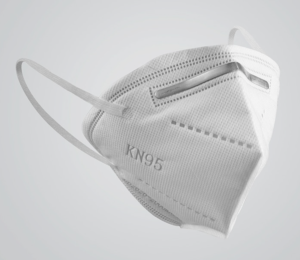
The N95 / KN95 / FFP2 masks are the mainstream weapon against Covid-19. Its name comes from each of the certification standards: N95 in the US, KN95 in China and FFP2 in Europe. Those certifications are similar, and for most purposes interoperable.
These masks have been designed and used for years to protect against fine dust from construction works, or other hazardous environments, and were often found on hardware stores. More recently, these masks found widespread usage in Asia, for atmospheric pollution protection, for which they’re extremely effective, specially against the diesel generated carbon particulate, often known as PM2.5. This happened after people got used to it as its usage was encouraged during the SARS epidemic.
The fact that these masks are specifically designed to protects against those very small particles, makes them nearly perfect to protect against airborne pathogens, such as bacteria and viruses. Its construction is far more sturdy than that of surgical masks: a very thick layer of non woven melt blown fabric, with a couple of ear straps and a metal plate to make a perfect fit. The effectiveness of these masks specifically depends on such a tight fit, as it’s not possible to ensure such a high filtering capability of the air enters through gaps on the sides or around the nose. This is one of the most important differences as compared with surgical masks. Although these offers high protection, it doesn’t come without caveats:
- These masks are (theoretically) single-use, and far more expensive than most others.
- Using these masks for long periods is strenuous, and causes breathing difficulties on those with preexisting conditions such as asthma or bronchitis
These masks are not medical grade, but due to the shortness of medical grade parts, there’s widespread usage amongst health workers, and are now formally accepted for medical usage. As many others, availability of these is extremely limited.
Contrary to surgical masks, prices for these masks have not risen significantly, most likely because they were already relatively expensive to start with. So you get need to find them. This time, it behaves just like surgical masks: Amazon doesn’t officially offers them, and the few that exist today are direct imports. However, it’s readily available from asian retailers through AliExpress, at around 2.5€ apiece.
N95 masks with exhaust valve
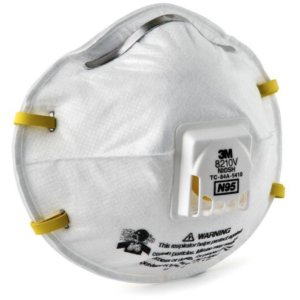
These are the very high end masks manufactured by leading companies such as 3M. Their aim is to improve user comfort without compromising filtration performance. These are the best possible masks you can get on a construction site. Not as great while on the middle of a pandemic.
The difference between these masks, and a regular N95 mask is the exhaust valve, that white plastic part in the middle. Its goal is to improve the air resistance while exhaling thereby reducing humidity and temperature inside the mask. It does make a huge difference to the user, especially when you spend a number of hours using one. It also improves the durability of the mask itself by reducing humidity, an issue which affect N95 masks over time. This however, is actually a tradeoff, reducing the outwards air resistance is done by placing a simple valve on it. It means that any outward air is unfiltered. As such, as great it may be to the user, if the user is already infected, it doesn’t protect others from the user’s viruses. This the the reason why these masks don’t qualify for medical grade, no matter how performant they are.
These masks do have other issues:
- They’re nowhere to be found, and due to the limited production capacity, that will not change for the foreseeable future.
- Price was already high before the Covid-19 crisis, and are now even more expensive
- They’re still single use, although methods are being developed to make them reusable, but even by reusable, it means less than 5 times.
In sum, these masks are not recommended to be used for the next couple of months, even if you’re able to find any available.
Surgical N95 Mask
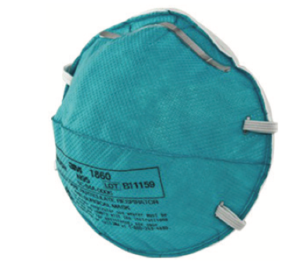 Let me start by “STAY AWAY FROM THOSE!”.
The surgical N95 mask is the improved N95 with enhanced resistance against liquids and timid environments, such as those experienced on intensive care units packed with ventilators.
The reason why these masks matter so much precisely due to the extreme conditions lived on the ICU rooms. Ventilated patients cause a huge number of viral particles to become airborne, creating a massively hazardous environment, causing thousands of health worker to become infected, and a number of them to perish. Unfortunately, medical school do take some years from a student’s life, so when students finally became effective and highly skilled doctors they’re already in their thirties, which causes the average age of a specialist to be higher than average. That makes health staff more vulnerable to the pandemic.
In sum, those are the only face masks health workers should use, as such, the general public those not touch them for the foreseeable future. Then we also don’t want the price of such material to get inflated, so again: STAY AWAY FROM THESE MASKS. There are other alternatives that offer similar protection, at a much reduced cost, which do not endanger the health staff.
Reusable KN95 masks
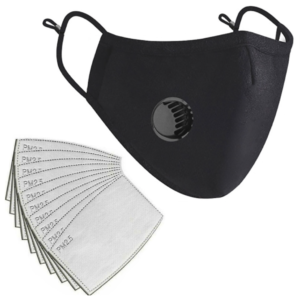
As I noted before, in Asia people noticed how well they felt after extended time using surgical masks during the SARS epidemic. Actually, not that well, but much less affected by the heavy pollution through the use of those masks. All of the sudden, there was the need for better masks: reusable, better looking, and much more performant, capable of being used while doing sports. The result: the Reusable KN95 mask.
Well, the name is a bit misleading. The mask itself is indeed reusable, but the filtering medium is disposable.
How does it work?
Reusable KN95 masks come a multitude of colours and formats, but they share the same basic construction: layers of synthetic cloth and an exhaust valve supporting a PM2.5 filter. The mask itself is washable and doesn’t actually does anything too relevant, other than some basic mechanical filtering, and more important it supports the filter in place, ensuring it is tightly fit around the face. All the filtering capabilities are solely dependent on the replaceable filter, which most often is a PM2.5 filter, capable of filtering at least 95% of all 2.5 μm particles. This allows these masks to be certified as KN95, as long as the used filter allows it.
These masks are indeed an evolutional step compared with all other non-medical masks:
- Low utilisation cost. For regular anti-pollution purposes those are good for at least a week, but for protection against viruses we can assume the filters can last at least as long as basic N95 mask. Filters can be purchased at about 20 cents apiece.
- High performance. Some masks offer very low air pressure drop, which means that filtering is achieved without compromising air flow, which is fundamental to allow the practice of any sports activity.
- Several colours and formats, from the most colourful, to the most sporty model
- and definitely not least, models for kids, with proper sizes and colourful themes.
Final remarks
Whatever happens, we’ll be stuck with a facemark for the next months, until a vaccine is readily available. It may seem dystopian but the simple action of leaving your home will have a cost. Just don’t get cheap on the your masks. From the simple surgical mask, to an advanced reusable KN95 mask. Out of all options, there’s one for all cases: cheap but effective single use, not so expensive and reusable. Just make sure you have one nearby when you leave your home.
[1] – Amy V Mueller, Loretta A Fernandez; Assessment of Fabric Masks as Alternatives to Standard Surgical Masks in Terms of Particle Filtration Efficiency; medRxiv 2020.04.17.20069567; doi:https://doi.org/10.1101/2020.04.17.20069567
[2] – MacIntyre CR, Seale H, Dung TC, et al A cluster randomised trial of cloth masks compared with medical masks in healthcare workers BMJ Open 2015;5:e006577. doi: 10.1136/bmjopen-2014-006577