Have you ever felt like an ant, when all other ants are going the other way? This is how the swedes are are now feeling. Not that the game has ended, as it’s barely past the 15 minute mark, but the current result is all but brilliant to Sweden.
There are only three possible approaches to the Covid-19 pandemic:
- Confinement and contention until a vaccine is available. This is the approach taken by most European and western countries plus all Asian developed and not so developed far eastern countries.
- Mild contention targeting a fast path to herd immunity. The path followed by Sweden.
- Zigzaging, incoherent and sometimes contradictory policy, as taken my countries with populist governments and or agendas, where we can fit countries like Brazil and the US.
Well, to be fair, we only have two possible approaches. Not having an approach cannot be considered one🙃.
Let’s have a deeper analysis on the Swedish mild contention approach:
- Schools and universities remained open
- Small shops and most commerce continued to do business as usual. Bars and coffees saw little new sanitary recommendations.
- Nursing homes and other locations with high number of highly vulnerable people were isolated from the general population, but healthcare workers were still allowed to come as go as needed. No mandatory screening of any such personnel. Here was were Sweden believed it was following the other countries contention measures. Unfortunately to many elder Swedes, that was not the case.
- No mandatory face mask on any occasion.
This approach, accordingly to Dr. Anders Tegnell, infectiologist, and the mastermind behind the Swedish strategy, would be able to maintain the entire society and economy working normally, simply by segregating all but the most vulnerable. This means isolating nursing and retirement homes from the rest of society, as well as older individuals living outside those facilities, from the rest of society. This would take as much advantage as possible of the swedes way of living, which is unique within Europe:
- Extremely low population density, with one single major metropolitan area which aggregates more than 20% of the country’s population. The remaining population is dispersed over the country’s 450 000 Km². Just to put these values in context, it corresponds to a sixth of the UK population spread over twice the area of the UK.
- Natural social distancing, where on the average household lives only only single generation, or at most two including school age children. Big family gatherings are not common, or at last not nearly as common as on the southern countries such as Italy or Spain.
In fact, if you think of it, if there’s one country where such as strategy would ever work, Sweden would be it.
What do the Swedish figures tell us
Statistics coming from Sweden are not strait forward to understand and actually requires significant processing. Both in terms of infections and fatalities. Sweden is known only to test those which not only present symptoms, but only when those symptoms represent a significant risk, requiring hospital care, which significantly reduce the number of known infections. The lack of proper testing was made all but too apparent the green activist Greta Thunberg become infected, but never tested, as published on Instagram.
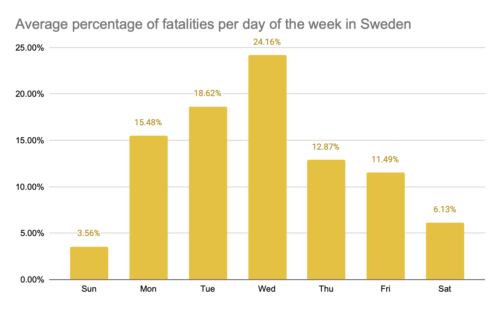
While the Swedish government set up an infrastructure to ensure hospital resources occupation would be under close control, including the all too important ICU beds and ventilators. And this is as far as it goes. In fact, trying to make sense of the fatality numbers is all but useless, as the next chart depicts.
Sweden is one of those countries where either the virus refuses to work on weekends, or there’s no record tracking of fatalities done during the weekends. Not that it matters a lot at the end of the day, but it does prevents anyone from taking any use of the country’s daily fatalities as those may only be recorded after 2 weeks. Unfortunately, this also means today’s figures corresponds to the reality a few days ago. But before you consider cursing Sweden, there are a number of other countries where this also happens, the most important of which is the UK.
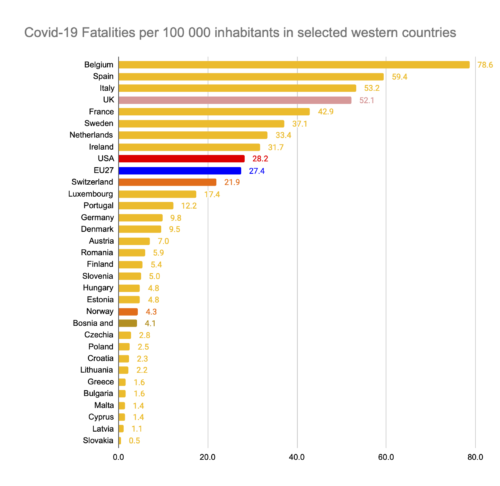
Ignoring the delay on reporting, Sweden is nonetheless the fifth European country where most people per capita have died of Covid-19, behind Belgium, Spain, Italy and France, but on the current trend its likely to overtake France in around 2 weeks. However, the most striking difference is between Sweden and its closest neighbors. Denmark, Finland and Norway, all have far less fatalities per capita, from less than a third in Denmark, to almost a tenth in Norway. These figures high list how different is the public policy impact regarding Covid-19, and how much different the results are from its closest peers. And to make matters more concerning, the fatalities curve in Sweden stubbornly refuses to abate.
Also, comparing the current infection rate, Sweden is performing worse than any other European country exhibiting the highest per capita infection rate.
All those results are the expected outcome of a policy of very light confinement, with the goal of reaching herd immunity as fast as possible, without making the health system collapse, nor endangering the economy.
The Swedish end goal
The entire Swedish approach is based on the assumption that it would be possible to overcome the pandemic without draconian confinement measures, thus preventing an economic meltdown and saving its citizens from all the stresses a long standing confinement brings. However, this strategy depends on two factors Sweden cannot easily control:
- It’s own population must not overreact on its own to the pandemic, by reducing its own internal consumption
- Other countries, to which Sweden exports must also continue to buy Swedish products, during the pandemic’s peak, and on the following moths.
Now, the interesting part, it that both factors rely evenly to what happens outside its borders. Public perception of the impact of the pandemic depends on not having news of massive fatalities outside its borders, such as what happened in Italy and Spain, and that Sweden’s neighbors also don’t show a very significant reduction of fatalities as compared with its own. If any of both happens, public awareness may trigger a self imposed economic lockdown with similar effects to those happening throughout Europe. Of course, if news of massive fatalities corresponds to those countries to which Sweden exports the most, so will exports to such countries be severely affected.
Where the cracks start to appear
The first pillar of the Swedish strategy is specifically to protect the most vulnerable groups, and specifically the elderly population living in the state sponsored, but privately operated nursing and care homes. Unfortunately, as other countries also found, preventing such facilities from being easy targets to the SARV-COV-2 virus proved painfully difficult, and for a number of reasons:
- Asymptomatic staff can be extremely contagious, and remain undetected for days.
- Medical staff also work on other health facilities, allowing them to easily become infected and infecting other staff and residents at those homes.
The level of failure was painfully obvious, as the victims to those home represent half the total number of fatalities. So high, the Swedish government government was forced to enact stricter measures on nursing home, including a very significant investment on adding new and better trained staff, to the tune of 2.2 billion krona ($229 million US). This kind of new investment is extremely politically sensitive in Sweden, from both sides of the question, as part of the Swedish social democrat doctrine is to partnership with the private sector to provide state benefits.
Still, it doesn’t seem Sweden is taking the nursing homes’ problems seriously enough, as the announced measures pale compared with what other European countries are doing, such as blanket testing of all nursing home personnel.
The cruelty of the Covid-19 IFR
Covid-19, as any other disease, has a natural fatality probability per infected person, also known as infection Fatality Rate (or IFR). In case of the common flu, this value was calculated at 0.1%. This means that for each 1000 people actually being infected by the flu, which excludes all those already immunised for the disease due to a vaccine, 1 is likely to die. Not only the fatality rate is low, but is virtually zero for those under 60 years old and without comorbidities.
Trying to ascertain the diseases IFR has been one of the most import scientific challenges of the pandemic, as that’s one of the two cornerstones of managing any epidemic. Initial figures from Wuhan, China, put that value at around 3.3%, but due distrust on any figure coming from China, everyone seemed to have ignored it. As Wuhan’s health system was known to have been overwhelmed on the initial stages, everyone blamed the reported high IFR value on it. In the meantime, as the dust settled in China, so did proper studies, resulting on a more palatable value around 1% from Wuhan((Estimating clinical severity of COVID-19 from the transmission dynamics in Wuhan, China;, Kathy Leung, Mary Bushman, Nishant Kishore, Rene Niehus ,Joseph T. Wu,Pablo M. de Salazar, Benjamin J. Cowling, Marc Lipsitch and Gabriel M. Leung)), and then reenforced by other studies based on world wide data1.
However, reinforcing the dismissive approach on the China data, earlier studies2 pointed to a lower value of 0.3%, which would still be three times as high as the flu. However, all those studies ignored other sad statistics of SARS-COV-2: fatalities happen around 20 days after infection, and until a patient is taken out of mechanical ventilation, there’s a 50% fatality probability. If you want to push a study, you can’t wait for all patients to be released from hospital, but maybe that should have been the case. However, some government bodies grabbed such a lower IFR values and based their entire policy around it, such as in Sweden.
The other unknown at the time, as how many people were actually being infected, given the fact that at least some had never shown any symptoms. Early analysis pointed to ratios as high a 100 times, which would support the low IFR value, but again, as proper studies appeared((Correcting under-reported COVID-19 case numbers: estimating the true scale of the pandemic )), that ratio was significant lowered into the “less than 10 times ratio”.
The biggest problem regarding such lenient approaches is the fact that no matter what governments do, is the fact that given Covid-19′ infection fatality ratio at around 1%, for an average age distribution pyramid, and western health systems, if you plan to allow 6 million people to become infected, 60 000 people will die from Covid-19. That would be the cost to attain herd humanity for a disease with Ro of 2 such as SARS-COV-2, resulting in an infection ratio of 60%((The disease-induced herd immunity level for Covid-19 is substantially lower than the classical herd immunity level;Tom Britton, Frank Ball and Pieter Trapman)) .
Underlying to the policy, is the hope that the infection would spread quickly through the young urban population of Stockholm. The expectation was that by May 1st, 30% of the Stockholm population would have had created immunity against to the disease. However, by April 21st the harsh reality set in, as investigators found only 11% of the population had developed antibodies against the disease. Never mind the fact that its yet to be demonstrated the level of antibodies required for immunity to set in.
Unfortunately for the Swedes, the figures from Wuhan were not wrong.
The Coupe de grâce
If the Swedes end goal was to protect the economy, accordingly to the recent forecast, it’s an utter failure.
First, it was the EU commission’s Spring forecast, where Sweden was estimated of having a very similar economic downturn as its northern European neighbours and to the EU average as a whole. Now, if that could have been considered wishful thinking from the EU commission censuring Sweden’s approach, Riksbank, Sweden’s central bank came up with a even darker scenario for the Swedish economy, thrashing any hopes of avoiding the economic fallout of the pandemic.
One of the reasons why Sweden would not be shielded from the economic effects on the economy, is the level of integration of the European supply chains, where one single part may go through several national borders before reaching a finished status.
Betting against the rest of the world
The last pillar of the Swedish strategy, lies on the possibility that immunity can be achieved ( otherwise the disease could only be managed by an effective drug), and that a vaccine will take too long to become available. Longer than what Sweden is willing to wait.
Now, there are countries which adopted the exact opposite strategy than Sweden, instead trying to eliminate the disease from within its borders. This strategy has been pursued by a number of countries, with different levels of democratic rule of law, such as New Zealand or China, corresponding at each of the spectrum. The advantage of such an approach is that, having eliminated the virus, you just need to keep it out, allowing the entire population to return to normality. The downside of such a strategy, it that is leaves the community completely unprotected against an uncontrolled second wave, whereas others might have achieved a small level of immunity. Controlling that risk is a problem with one single solution: get a vaccine.
So, when the rest of the world, including China, set the target of obtaining a vaccine before the next winter, you’re just giving humanity’s entire scientific and industrial might one goal: obtain the vaccine. Never mind the fact that China cannot even attempt to lockdown the entire nation in case of a second outbreak. It would be immensely deathly to China if a second outbreak happens before a vaccine is available. So, China put in motion its entire economic and military might in the quest for a vaccine. This vaccine doesn’t even needs to tremendously effective nor safe. It only needs to be 60% effective, and not to kill more than 0.1% of it’s users. That would be sufficient for China to be safe from a second outbreak, and that needs to happen before November. This is China’s equivalent to the Apolo Program.
In the meantime, apart form the more than 10 vaccine projects from China, there are another 40 being developed around the world. And out of those 50, you only need one to work, two, if you need “western style safety” and effectiveness. Leaving China developing a quick and dirty vaccine, and a bullet proof, high effective vaccine on the western world. Even then, any vaccine that achieves a bare minimum level of immunity, and available in quantities sufficient to be applied on the risk groups, is all you need in the short term.
Finally, is just when your testing a vaccine you actually get to know which are the levels of anti bodies you need to get to actually need to become immune to the disease. This means that not all those infected will attain a level of immunity to endure for more than a few months. In effect, Sweden also needs for someone to develop a vaccine.
All said and done, at this moment, there are only two possible outcomes: either Sweden is right, and rest of the world fails, and a vaccine won’t be available in the next 12 months, and will pay the deadly price of obtaining herd immunity. Or any one of the vaccine projects around the world succeeds and Sweden would have paid a huge price for experimenting fighting a pandemic with its own population.
Let Sweden take its path
Notwithstanding the current negative position, it’s paramount to the rest of the world that Sweden maintains its path. Contrary that may seem, the fight against Covid-19 isn’t even at half time, and there’s yet a lot to be played. Sweden might yet be proven correct. Countries may realize that reviving economies might never be possible without opening up to a level and cannot contain the spread of the disease to disastrous levels.
Even if Sweden’s plan never succeeds, it’s critical to have evidence of what happens if you don’t contain the disease. This allows people to counteract attempts from populists from offering easy ways out of the pandemic or the economy. This has been so successful, that even on hard hit countries, where the populist moment have had some success in the past, such as Italy, populists have all but been silenced due to the complete lack of a credible narrative. In fact, even on countries with lesser populist presence, such as Austria and Germany, pools put those forces on minimum levels, not seen in several years.
So, by all means, don’t prevent Sweden from swimming against the flow. Because, no matter the outcome, the entire world wins.
- Estimating the Global Infection Fatality Rate of COVID-19;Richard Grewelle, Giulio De Leo;medRxiv 2020.05.11.20098780; doi:https://doi.org/10.1101/2020.05.11.20098780 [↩]
- The clinical characteristics of COVID-19: a retrospective analysis of 104 patients from the outbreak on board the Diamond Princess cruise ship in Japan; [↩]
Pingback: Sweden jumps into top 5 of the countries most effected by Covid-19 - Covid-19 Report