Note: At the time this post was published, IFR in Germany stands at 1.08%.
There is one and only one argument people electing to overlook the COVID-19 pandemic take: the infection fatality rate is being vastly overstated. In order to understand how overstated it is, it’s fundamental to know the ratio of asymptomatic infections.
The fundamental lead indicator of how bad the Covid-19 pandemic can be is the Infection Fatality Rate (IFR). This indicator allows governments to calculate the final number of deaths, based on the number of infections. However, the IFR is defined as the total number of infections, including those which are asymptomatic or those who were never formally diagnosed with he disease. So, on one hand, this indicador may be very pessimistic, because we all know ultimately not all those infected will ever get diagnosed, but on the other hand, while the pandemic is still progressing, it also assumes that all current infected will not die was well.
Then there’s the problem of how reliable are the Chinese figures. Literally ever doubts the Chinese figures, the problem is, which figures do you doubt the most? The number of infections, or the number of deceased. And here lies the problem. If China withhold the real number of infections, it means the reported IFR is in reality lower. However, why would China do it?
On the other hand, China might hand underreported the number of deceased, and that would be done for a good reason: make the Communist Party look better. However, that also has a tremendous effect: it underestimates the IFR, to values higher than 3%.
So, people started to look elsewhere. And one of the thing people started to look was for population groups: regions, entire countries, cruise ships.
Cruise ships gives you a good approximation, it’s a closed environment, actually to close, which make the pandemic spread faster, but, but there’s a big but. The cruise ship population is extremely skewed, as most people are older than the average population. Nevertheless, that calculation was already done, and the outcome is 18% of asymptomatic cases, and then an IFR of 1.1%.
For some people this value is simply to high. To make this figure real, it means that, in the US, if the same number of people are infected with the flu, are now infected by Covid-19, you’d get 3.4 million dead. So people started to look elsewhere, to other reference countries.
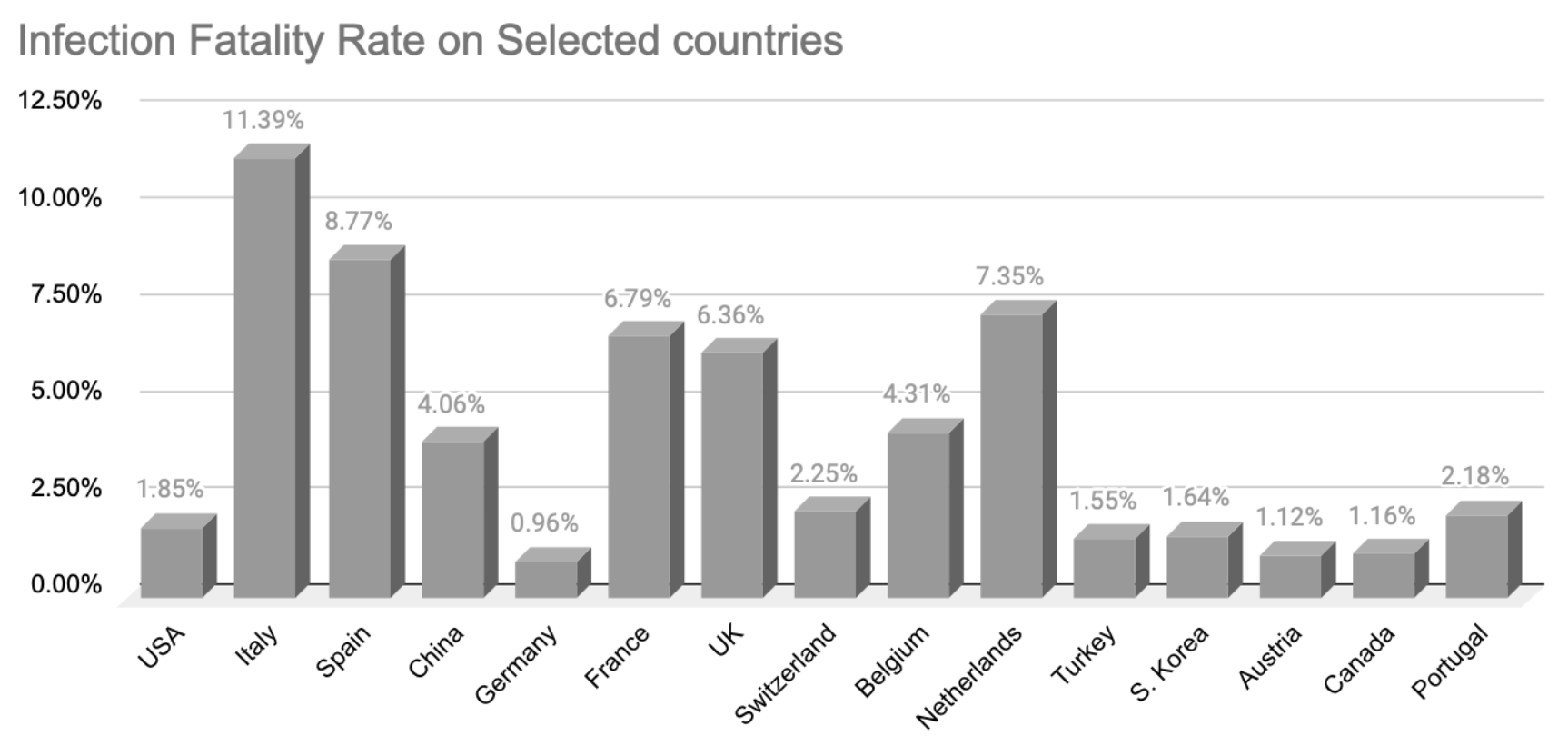
Two of those countries were South Korea and Germany.
South Korea has been battling the virus since the early beginning, and with some excellent results given the situation. It did it by testing a huge portion of the population on a certain area, regardless of symptoms. By the end of February, the results were excellent: single digit spread, IFR at around 0.7%. But a significant number of people were still on the intensive care units (ICU). This is where this disease is a bitch. People on the ICU kept dying weeks after getting infected, which brought South Korea figures into the current 1.64% IFR, and raising each day.
Again, we just need to find one single country that can achieve a lower value, and it can be assumed as a reference value.
Then it came Germany. Germany has from the beginning reported a significant number of infections, reaching 60 thousand infections in a matter of weeks, and apparently due to the average age of the infected, deaths were not coming. Then came the bitch. The Imperial College places the average time to death at 16 days, with a very long tail. The next chart describes what happened next:

IFR always starts low, and then it increases, and keeps increasing. This may have 2 explanations:
- Germany started to loose track of the asymptomatic infected, to very low levels
- IFR is really that high, and time just took its course.
Let’s just hope germans are incompetent, and as such IFR is much lower than anticipated.